
Pool Finishes in Leander, TX: Plaster, Quartz, Pebble and Polished Compared
White plaster, quartz, pebble, polished aggregate and fiberglass gelcoat compared on feel, hard-water wear and price, then quoted in writing after a free inspection.
- Free on-site inspection
- Written itemized quote
- Plaster, quartz, pebble and polished options compared
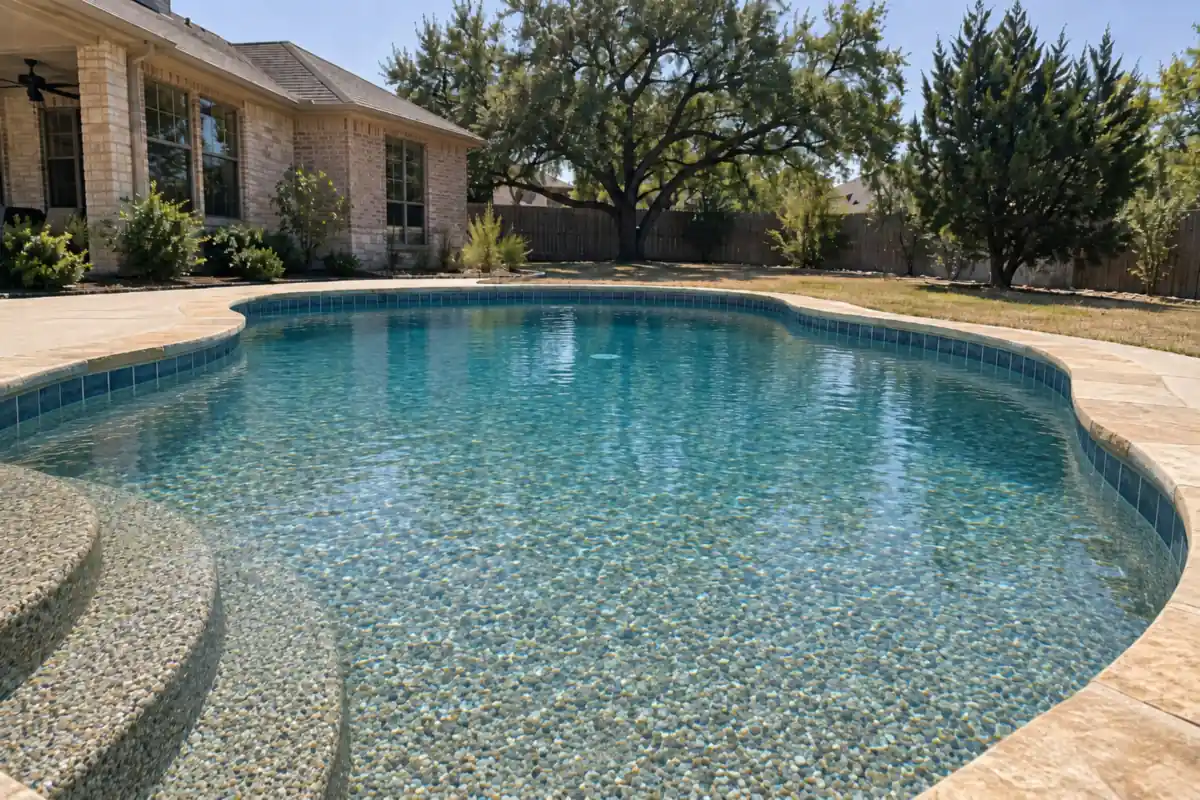
Leander Pool Resurfacing installs the pool finishes Leander homeowners want: white plaster, quartz, exposed pebble, polished aggregate and fiberglass gelcoat. The fill water should pick the finish, not the brochure. Every one is quoted in writing after a free on-site inspection; call (555) 555-0100 to book it.
Pebble pool finish
Exposed pebble outlasts the other cement finishes in hard water: small stones locked in cement paste, washed proud before the crew leaves, then acid washed the next morning. Roughest underfoot, $7,000 to $12,000. Feel one before you choose a pebble finish.
Quartz pool finish
Quartz aggregate plaster is the middle path: smoother than pebble, tougher than plain marcite, closest to old plaster underfoot. It goes on, exposes and acid washes like pebble, $6,000 to $9,000 on a typical pool. See a quartz finish for colors.
Polished aggregate finish
Polished marble and glass bead finishes give a smooth, glassy feel with an aggregate finish's hard-water durability. The crew installs, exposes and polishes it like pebble, and that extra labor sets the price above standard pebble. A polished finish is the answer when pebble feels too rough.
Fiberglass pool resurfacing
A fiberglass shell cannot be plastered like gunite. It gets a new gelcoat, or an aggregate finish bonded to a prepared shell, after grinding and repairing blisters and cracks. A basic gelcoat runs $5,000 to $8,000; fiberglass pool resurfacing covers the tougher tiers too.
Plaster, quartz, pebble and polished: how the finishes compare
Pick by feel, then by price. Leander's 2024 water report lists 194 ppm hardness; the table below runs in the order the finishes resist scale and etching.
| Finish | Underfoot | In hard water | Best for |
|---|---|---|---|
| White plaster (marcite) | Eggshell smooth | Scales and etches first | Lowest cost |
| Quartz aggregate | Between plaster and pebble | Outlasts plain plaster | The middle ground |
| Exposed pebble | Roughest | Longest of the cement finishes | Hard water, long service |
| Polished aggregate | Smooth and glassy | Pebble durability, roughness polished off | Bare feet and kids |
| Fiberglass gelcoat | Smooth | Blisters and cracks are the tells | Fiberglass shells only |
A white plaster replaster still means a real troweled cement finish, just with less stone in it.
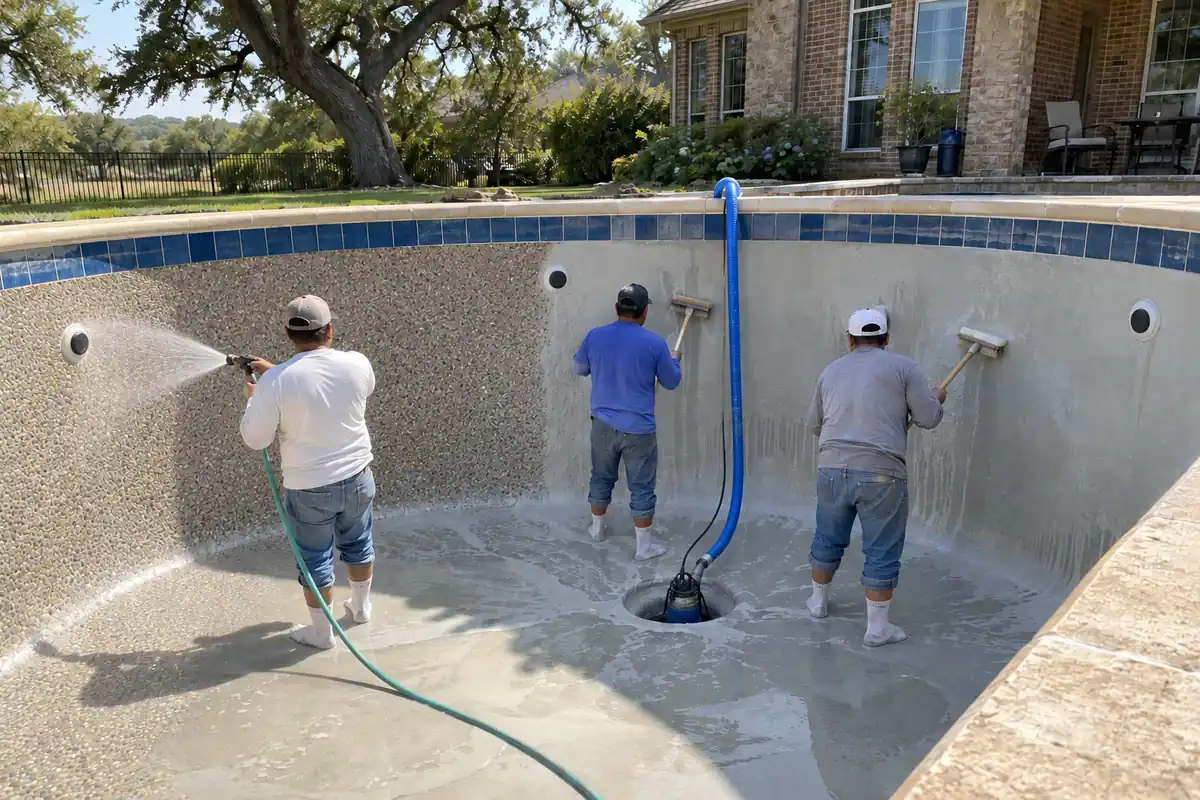
How a finish job runs, drain to refill
Six steps, tile before finish.
- Drain-down. About an hour by sump pump, dechlorinated first; hydrostatic plugs come out so the shell cannot lift.
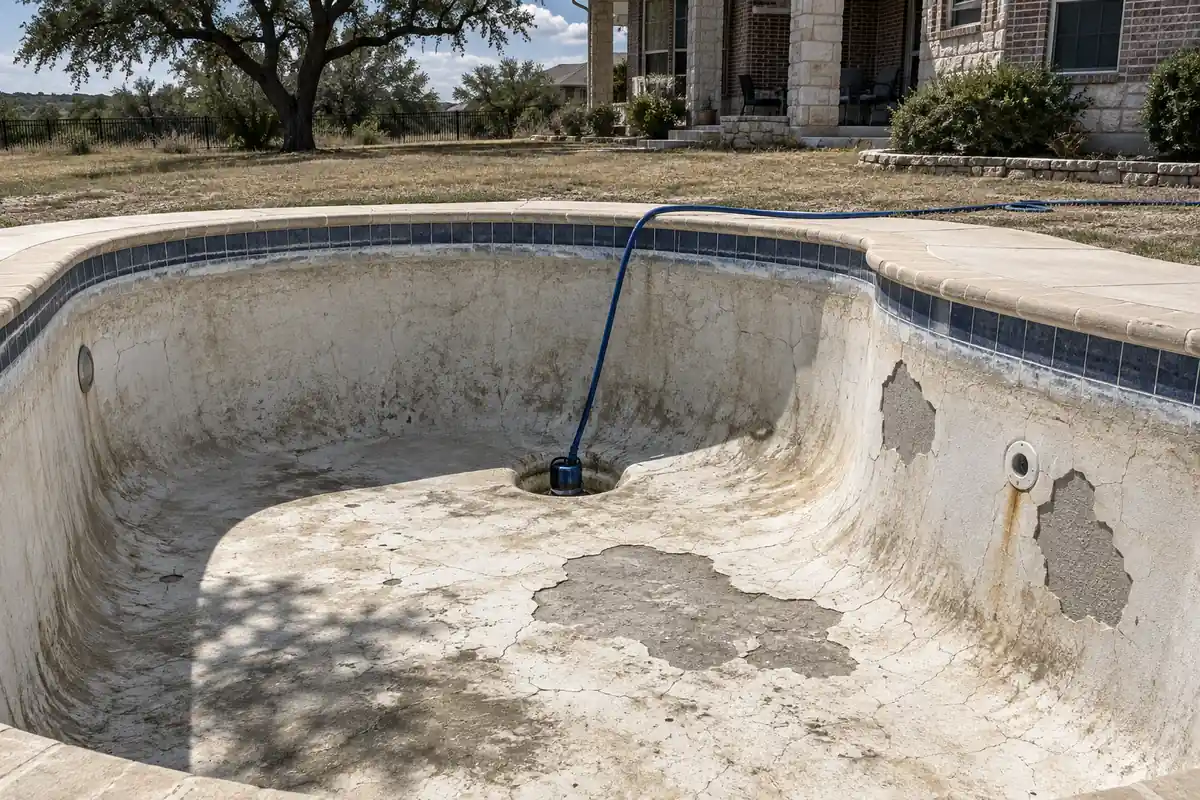
- Chip-out or bond coat. Delaminating plaster is chipped to the gunite and undercut at tile and fittings; sound plaster gets a bond coat, finish within 3 to 5 days.
- Tile and coping. About 1.5 hours to strip a band, 1.5 to 2 for the skim coat, 3 to set tile; see tile and coping.
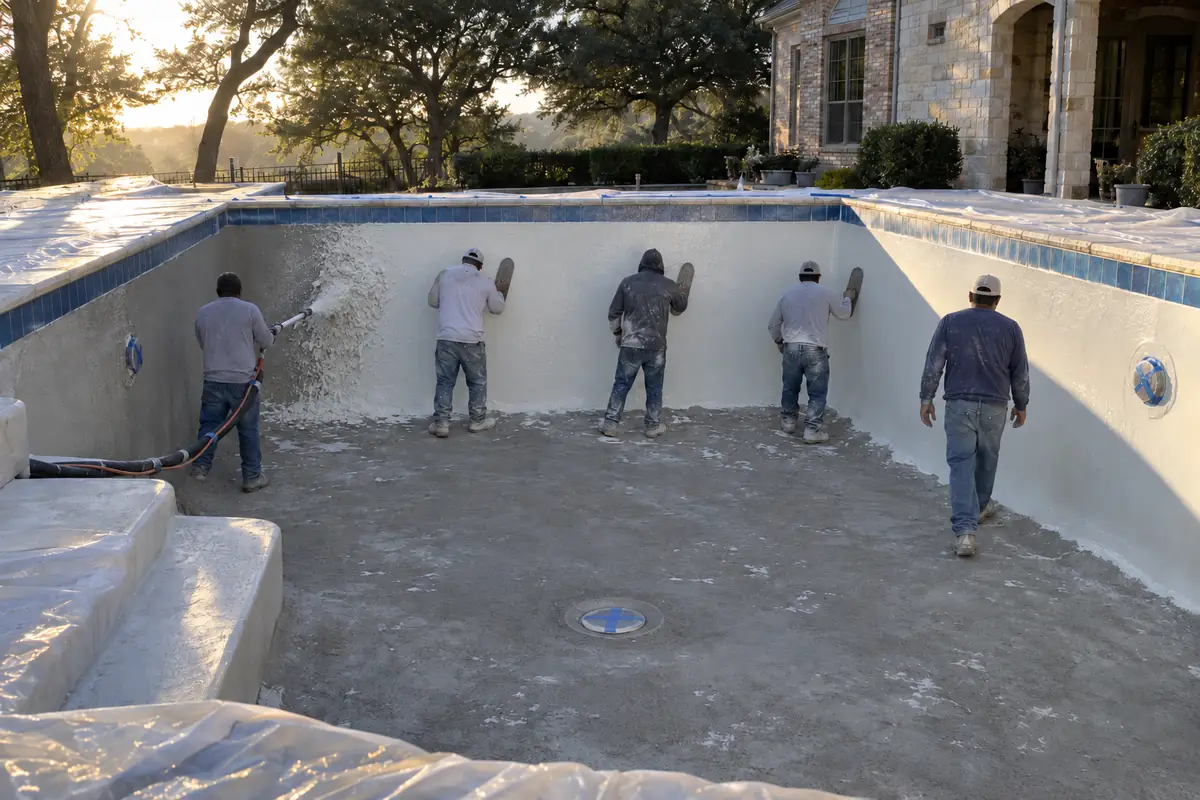
- Plaster or pebble day. Five to eight finishers mix it on the street at first light, pump it through a hose, and work walls first, floor last, in spiked shoes: two to four hours.
- Exposure and acid wash, aggregate only. A water wash of about an hour, a next-day acid wash of about three; white plaster fills at once.
- Fill and 28-day startup. A cloth-wrapped hose at the deepest point, never stopped, 6 to 24 hours after the last trowel; then brushing, no chlorine for 48 hours, no swimming for 7 days.
Why Central Texas water and soil wear out finishes
Leander fills pools from Lake Travis; the City of Leander's 2024 water report lists 194 ppm hardness, 156 ppm alkalinity and pH 8.2, high against startup targets of 80-100 ppm and 7.2-7.6.
West of I-35 the ground is thin soil over limestone; east of it, Blackland clay shrinks and swells, lifting coping and opening plaster. Camp Mabry logged 80 days at or above 100 F in 2023, 45 in a row: a hot, dry shell sets plaster too fast and cracks. About two thirds of Leander's homes date from 2000-2019, so plenty of original plaster is due at once.
How much do pool finishes cost in Leander?
Most quotes fall between $4,500 and $12,000 for a typical 12,000-18,000 gallon pool. Finish material moves the number first, then prep: a full chip-out costs more than a bond coat over sound plaster, decided at the inspection.
Waterline tile added at the same time runs $15 to $35 per linear foot. Every job is priced from a site visit; call (555) 555-0100 for the written quote.
| Work | Typical range | Notes |
|---|---|---|
| White plaster (marcite), drain to refill | $4,500 to $7,000 | |
| Quartz aggregate finish | $6,000 to $9,000 | |
| Exposed pebble finish | $7,000 to $12,000 | |
| Polished aggregate, mini pebble tier | $7,500 to $17,500 | Marble and glass bead tiers run higher |
| Fiberglass gelcoat refinish | $5,000 to $8,000 |
Swipe the table sideways to see the notes column.
Typical ranges for a 12,000 to 18,000 gallon pool; every job is priced from a site visit.
Pool finishes across Williamson County and northwest Austin
The crew drives from Leander to every town on the service areas list, including Cedar Park, about seven minutes down US 183 where more than half the homes date from 1990 to 2009, and Round Rock, about twenty minutes east, where hardness reads 249 mg/L, an argument for pebble or quartz.
What happens when you call
The inspection
The estimator comes to the property, looks at the work in person, measures, and checks the things that change the price before quoting anything.
A written, itemized quote
Every line item goes on paper before any work starts: prep, materials, labor, cleanup and the scheduling window. No verbal numbers.
Warranty terms in the contract
Workmanship and material warranty terms come in writing and go in your contract so you can read them before you sign.
Scheduling you can plan around
You get a start window and a working-day estimate up front, and the crew tells you before anything changes.
Who this is not for
Leander Pool Resurfacing handles pool resurfacing and the related work listed on this site. It does not take on unrelated trades; if your job is outside that scope, a specialist in that trade is the right call.
Pool finish questions from Leander homeowners
White plaster, quartz or exposed pebble: which makes sense for a Leander pool filled from hard lake water?
Pebble if the budget allows, quartz if not. Leander's 194 ppm hardness (2024 report) means aggregate finishes outlast plain plaster. Pebble runs $7,000 to $12,000 against $4,500 to $7,000 for plaster.
Which interior finish gets the most years out of Central Texas water before it has to be redone?
Exposed pebble outlasts quartz, and quartz outlasts plaster, but nobody puts a year count on any of them. Fill water, startup and brushing matter as much as the bag. A drummy sound or returning scale means it is done.
On a tight budget, which finish costs the least while still being a real resurface, not a paint job?
White plaster, $4,500 to $7,000 on a typical pool, is the least expensive real finish: cement and marble sand pumped through a hose and troweled by a crew, not a roll-on kit. The only roller on a real job touches the bond coat.
Are brand-name pebble and quartz products different from a plasterer's own blend, or the same aggregate in a different bag?
Same material classes, pebble and quartz aggregate, sold as a factory blend or mixed at the mixer from aggregate, pigment, modifier and cement. The undercut at tile and fittings, the exposure and an uninterrupted fill matter more than the label.
Is a weekend roll-on kit a real substitute for a troweled finish, or does it peel by the second summer?
No. A real finish is mixed at the street, pumped through a hose, and troweled by finishers in spiked shoes. The only roller on site touches the bond coat, never the finish.
Will a dark finish come out blotchy, and is that mottling a defect or just how colored plaster looks?
Some shading is normal on a colored or aggregate finish; it never looks as uniform as paint. Heavy blotching or streaks point to workmanship, not chemistry, and belong under warranty. Soft or hollow spots point to pool plaster repair instead.
Feel a finished pool of each type before you choose, and let the water report break the tie, not the showroom sample. Call (555) 555-0100 or send the form; the estimator sounds the shell and writes every line item down before a chip comes off.
Get a written quote
Call (555) 555-0100 or send the form. The next step is a free on-site inspection and a written quote with every line item before any work starts.
Call (555) 555-0100